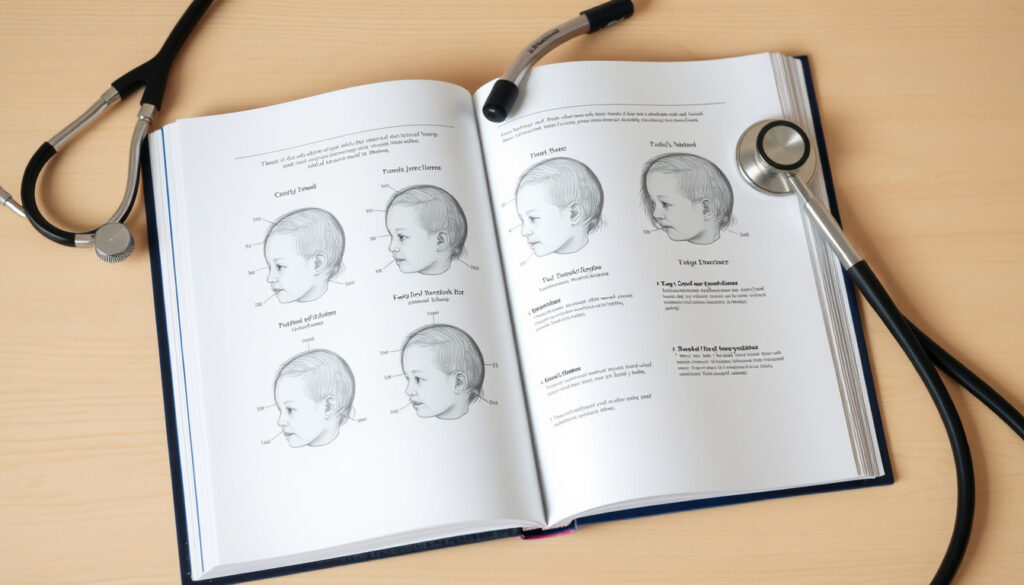
Fetal Alcohol Syndrome Face – Key Features, Photos and Medical Guide
The fetal alcohol syndrome face is defined by a specific set of structural abnormalities that arise from prenatal alcohol exposure during the first trimester. Three cardinal features—short palpebral fissures, a smooth philtrum, and a thin upper lip—form the core of the diagnostic criteria, though not every individual with fetal alcohol spectrum disorder (FASD) exhibits them.
These facial characteristics are most visible in infancy and early childhood. As facial growth progresses, some features may become less pronounced, making identification in adolescents and adults more challenging. Researchers have developed standardized scales and 3D imaging tools to improve diagnostic accuracy across age groups.
Understanding the typical FAS face helps clinicians distinguish the full syndrome from milder forms on the spectrum. It also highlights the importance of evaluating growth and neurodevelopment alongside facial morphology, since the absence of dysmorphic features does not rule out alcohol-related brain damage.
How does the fetal alcohol syndrome face compare to a normal face?
Small horizontal eye openings (inner to outer corner width) below the 10th percentile for age.
Reduced vermillion thickness of the upper lip (thin upper vermillion) ranked 4 or 5 on the Astley lip scale.
Absence or flattening of the vertical groove between nose and upper lip, ranked 4 or 5 on the Astley philtrum scale.
Underdevelopment of medial nasal processes leads to a short, upturned nose and flattened nasal bridge.
Key insights
- The three cardinal facial features of FAS are short palpebral fissures, smooth philtrum, and thin upper lip.
- Not everyone with prenatal alcohol exposure has these facial features; they indicate the full syndrome (FAS) rather than the broader FASD.
- Facial features may become less distinctive with age, making diagnosis in adults more challenging.
- Gender differences in FAS facial features are not well documented; current literature suggests equal prevalence but possible subtle variations.
- Reliable medical sources for visual references include peer-reviewed journals and CDC educational materials; social media provides anecdotal experiences but lacks diagnostic validity.
Snapshot facts
| Feature | Description | Source |
|---|---|---|
| Short Palpebral Fissures | Distance from inner to outer corner of eye is below the 10th percentile for age | Cleveland Clinic / PubMed |
| Smooth Philtrum | Philtrum ridge absent or flattened (rank 4 or 5 on the Astley philtrum scale) | Birth Defects Research / Fasdclinic |
| Thin Upper Lip | Upper lip vermillion border is thin (rank 4 or 5 on the Astley lip scale) | Cleveland Clinic / PubMed |
| Additional findings | Short nose, underdeveloped nasal bridge, microcephaly, and epicanthal folds | Birth Defects Research |
What does the fetal alcohol syndrome face look like in adults?
Facial features peak in visibility during early childhood (birth to 6 years) and often fade with age due to differential facial growth. Longitudinal data from the CIFASD study show that FAS faces grow faster in some areas, leading to a subtler appearance in adulthood.
Changes from childhood to adulthood
The classic triad—short palpebral fissures, smooth philtrum, and thin lip—is most pronounced in babies and young children. In adults, these features may normalize but bone structure differences often remain, such as a less prominent profile. Not all adults with FAS display the full triad; severity depends on the amount of prenatal alcohol exposure and genetic factors.
Adults with FAS may appear facially unremarkable despite significant cognitive and behavioral impairments. Diagnosis often relies on historical records and dynamic facial analysis, such as 3D imaging, which can detect subtle traits invisible in 2D photographs.
What does the fetal alcohol syndrome face look like in an adult female?
The available literature does not document sex-specific differences in FAS facial dysmorphology. Both males and females with FAS exhibit the same core features, though hormonal and growth factors may influence soft-tissue appearance. The same diagnostic criteria apply regardless of gender.
What does the fetal alcohol syndrome face look like in boys and girls?
No systematic studies have established distinct facial phenotypes for boys versus girls with FAS. Current evidence suggests that the prevalence of the three cardinal features is comparable across sexes. Any observed variation is likely attributable to individual differences in exposure timing, dosage, and genetic background rather than gender.
Subtle differences in growth patterns
While the facial features themselves do not differ by sex, growth deficits associated with FAS—such as microcephaly and short stature—may present differently due to baseline population differences. Clinicians should use age- and sex-standardized growth charts when assessing a child for FAS.
Where can I find fetal alcohol syndrome face photos?
Reliable medical photographs are available from several authoritative sources. The University of Washington FAS Diagnostic & Prevention Network provides instructional images of Rank 4-5 philtrum and thin upper lip compared to normal. MedlinePlus offers a classic image of an infant with FAS showing growth retardation and facial dysmorphology. Birth Defects Research includes labeled photographs demonstrating short palpebral fissures, smooth philtrum, thin lip, and midface hypoplasia. Getty Images hosts a collection of 78 stock photos of FAS cases for clinical reference.
Social media platforms like Reddit contain anecdotal posts about FAS facial features, but these are not diagnostically validated. Medical diagnosis should rely on standardized scales and clinical evaluation, not user-shared images.
3D imaging technology, as used by the CIFASD consortium, can detect subtle facial dysmorphology that is invisible in standard 2D photos. This improves identification of FAS across diverse populations and age groups.
What are the other symptoms of fetal alcohol syndrome?
Beyond the facial features, FAS involves growth deficits—such as low birth weight, microcephaly, and short stature—as well as central nervous system abnormalities. These include intellectual disabilities, attention deficits, poor impulse control, and memory problems. The full diagnosis requires confirmed prenatal alcohol exposure, three facial features, growth impairment, and brain dysfunction.
When do FAS facial features emerge and how do they change over time?
FAS facial features result from alcohol exposure during the first trimester (weeks 3-8 of gestation) when craniofacial structures develop. Features are typically identifiable at birth and persist into adulthood, though soft-tissue changes (e.g., lip thickness) may become less pronounced. Diagnosis often occurs in childhood, but adults may be identified retrospectively through historical records and dynamic facial analysis.
- Weeks 3-8 gestation: Alcohol disrupts neural crest cell migration and medial nasal process development.
- Birth: Full triad may be present; microcephaly and low birth weight noted.
- Infancy to early childhood (0-6 years): Facial features are most pronounced; strabismus and vision problems common.
- Adolescence: Soft-tissue features may become less distinctive; growth deficits persist.
- Adulthood: Facial features often subtle; diagnosis relies on historical records and 3D imaging.
What is known and what remains uncertain about the FAS face?
| Established information | Information that remains unclear |
|---|---|
| Short palpebral fissures, smooth philtrum, and thin upper lip are the three diagnostic facial features of Fetal Alcohol Syndrome. | Whether facial features persist exactly the same into adulthood – some studies suggest they may become less distinctive. |
| These features are caused by prenatal alcohol exposure during the first trimester. | Whether gender differences exist in facial dysmorphology – current evidence is inconclusive. |
| Facial features can be objectively measured using the 4-digit diagnostic code (Astley & Clarren). | The accuracy of facial recognition software for diagnosing FAS in diverse populations. |
Why is the FAS face only part of a broader diagnosis?
The facial features of FAS are highly specific but present in only a minority of individuals with prenatal alcohol exposure (FASD). Overemphasis on the face can lead to underdiagnosis of non-dysmorphic forms of FASD. Recent research emphasizes that the absence of facial features does not rule out significant alcohol-related neurodevelopmental damage. Clinicians should use the facial features as a starting point, not the sole criterion.
What do authoritative sources say about the FAS face?
“What does fetal alcohol syndrome look like? Small width of eye opening (from inner to outer corners), smooth ridge between nose and upper lip.” — Cleveland Clinic (2026)
“Classic facial characteristics of fetal alcohol syndrome (FAS) are shortened palpebral fissures, smooth philtrum, and thin upper vermillion.” — PubMed (Suttie et al., 2013)
“Underdevelopment of the medial nasal processes leads to the short nose, smoothness of the philtrum, and underdevelopment of the upper lip in FAS.” — Birth Defects Research (Del Campo, MD)
What is the takeaway for recognizing the FAS face?
The FAS face is defined by three measurable structural features that arise from first-trimester alcohol exposure. These features are most clear in early childhood but can become subtler with age. Diagnosis requires a comprehensive evaluation of growth, brain function, and exposure history, not just facial appearance. For more on early pregnancy health, see 1 Week Pregnancy Discharge – Colors, Signs and What to Expect. Understanding blood health is also important; read about Red Blood Cell Count – Normal Range, High and Low Causes.
Frequently asked questions about the fetal alcohol syndrome face
What is the difference between FAS and FASD?
FAS is the most severe form of FASD. FAS requires all three facial features plus growth and neurodevelopmental impairment. FASD includes partial FAS and alcohol-related neurodevelopmental disorder (ARND), many without facial features.
Can FAS face be corrected with surgery?
Some surgical interventions can address specific features like a thin upper lip or short nose, but they do not treat underlying brain damage. Cosmetic surgery is rarely indicated and should be evaluated case by case.
Is the FAS face always present at birth?
The facial features are typically present at birth and can be diagnosed in infancy. However, some features (like lip thickness) may change with growth, making diagnosis in older individuals more challenging.
Can someone have FAS without facial features?
Yes. The facial features define full FAS, but many individuals with prenatal alcohol exposure have alcohol-related neurodevelopmental disorder (ARND) without dysmorphology.
How are FAS facial features measured?
Clinicians use the 4-digit diagnostic code (Astley & Clarren) which measures palpebral fissure length, philtrum smoothness, and lip thickness on standardized scales.
Are FAS facial features the same in all ethnic groups?
Studies from South Africa and Finland show that the core features (short fissures, smooth philtrum, thin lip) are consistent across populations, though population-specific norms may be needed for measurements.
Can 3D imaging replace clinical examination?
3D imaging improves detection of subtle dysmorphology not visible in 2D photos, but it complements rather than replaces a full clinical evaluation by a specialist.
What should I do if I suspect FAS in a child?
Consult a developmental pediatrician, geneticist, or specialist clinic experienced in FASD for a formal evaluation using the 4-digit diagnostic code.
More related posts
 Newcastle vs Leicester City – Prediction, Result and Stats
 Leeds United vs Arsenal F.C. – Match Preview and Key Stats
 Cass Elliot – The Ham Sandwich Death Myth Debunked
 How to Invest in Stocks – Beginner Guide for UK Investors 2025
 Jake Canuso – Biography, Career and Benidorm Role
 Thomas Shelby – Complete Character Guide and Biography
 Lighting Switch UK – Complete Guide to Types, Wiring & Buying
 Lady Macbeth – Complete Guide to Character and 2016 Film
