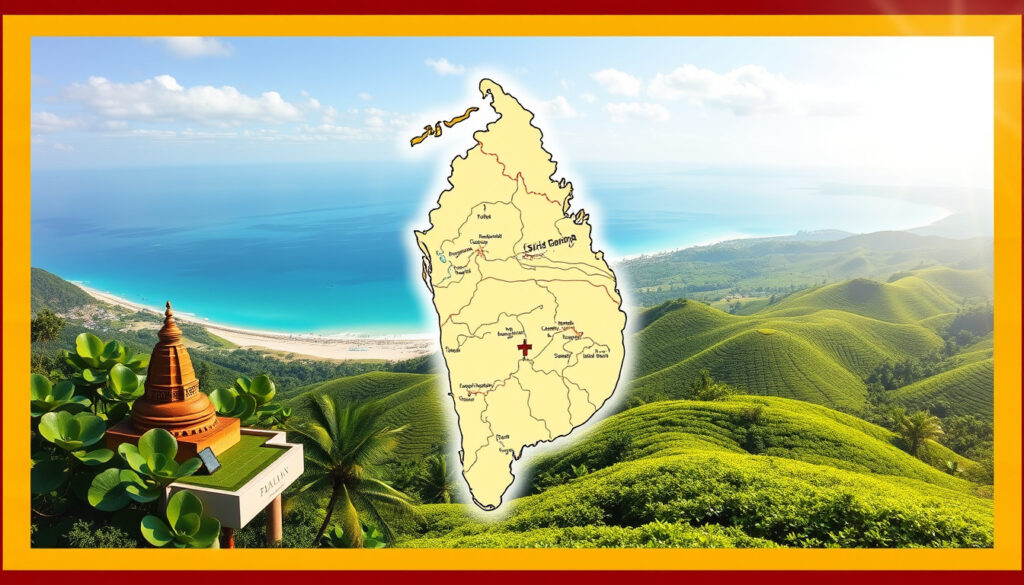
Sri Lanka – Capital, Religion, Language, and Key Facts
Sri Lanka, known as the Pearl of the Indian Ocean, is an island nation in South Asia with a recorded history spanning more than two millennia. Its unique dual-capital system, diverse ethnic fabric, and rapidly recovering economy make it a country of considerable global interest.
Located in the Indian Ocean just off the southeastern coast of India, separated by the Palk Strait, Sri Lanka covers 65,610 square kilometres. The island’s geography ranges from coastal plains in the north to hills and mountains in the interior, surrounded by the Indian Ocean, the Gulf of Mannar, and the Palk Strait. This strategic position on ancient maritime routes has shaped its multicultural identity over centuries.
With a population estimated at roughly 22 million as of 2026, the country is home to Sinhalese, Tamils, Sri Lankan Moors, Burghers, Malays, Chinese, and the indigenous Vedda people. Life expectancy stands at 73 years for men and 80 years for women, reflecting a healthcare system that has seen steady improvement.
What is the capital of Sri Lanka?
Sri Lanka operates a dual-capital system. The executive and judicial capital is Colombo, the largest city and the country’s political and financial centre. The legislative capital is Sri Jayawardenepura Kotte, where the parliament sits. Both cities function together to govern the nation, a distinction that often surprises first-time visitors.
Colombo
Sri Jayawardenepura Kotte
Sinhala, Tamil; English widely used
Sri Lankan Rupee (LKR)
- Sri Lanka is an island nation in the Indian Ocean, known for its ancient Buddhist culture and diverse natural landscapes.
- The country has a unique dual-capital system: Colombo as the commercial capital and Sri Jayawardenepura Kotte as the legislative capital.
- Buddhism is the dominant religion, followed by Hinduism, Islam, and Christianity, reflecting a multi-ethnic society.
- Sri Lanka’s economy relies on tourism, tea exports, textiles, and remittances; it is recovering from the 2022 economic crisis.
- The island has eight UNESCO World Heritage Sites, including the ancient cities of Anuradhapura and Polonnaruwa.
- Approximately 70% of electricity comes from renewable sources — hydropower, solar, and wind — as of 2025.
| Fact | Value |
|---|---|
| Official Name | Democratic Socialist Republic of Sri Lanka |
| Area | 65,610 sq km (25,330 sq mi) |
| Capital (executive/judicial) | Colombo |
| Capital (legislative) | Sri Jayawardenepura Kotte |
| Largest City | Colombo |
| Time Zone | UTC+5:30 (no daylight saving) |
| Calling Code | +94 |
| Drives on the | Left |
| Internet TLD | .lk |
What is the main religion and language of Sri Lanka?
Religion and language in Sri Lanka are closely tied to ethnicity. The majority Sinhalese population — about 74% — are Theravada Buddhists, and Buddhism has been given a primary place in the constitution since the country became a republic in 1972. Tamil-speaking Hindus, Muslims (including Sri Lankan Moors), and Christians make up the remainder of the religious landscape. Official census data comes from 2012, so exact contemporary percentages vary across estimates.
What language is spoken in Sri Lanka?
Sinhala and Tamil are the two official languages of Sri Lanka. Sinhala is spoken by the Sinhalese majority, while Tamil is used by the Tamil population and also by many Sri Lankan Moors as a first language. English is widely spoken in urban areas, government offices, and the tourism sector, serving as a common link language.
Who are the Sri Lankan Moors?
The Sri Lankan Moors are an ethnic minority of Arab descent, predominantly Muslim, who have lived on the island for centuries. They speak Tamil as their first language and are concentrated in coastal cities and towns. They are a real, historically documented community — not a fictional or outdated term.
What food is Sri Lanka known for?
Sri Lankan cuisine is built around rice and curry, hoppers (bowl-shaped rice-flour pancakes), kottu roti (chopped flatbread with vegetables and meat), and string hoppers. Coconut milk, cinnamon, cardamom, and chili are central to almost every dish. Ceylon tea, grown in the central highlands, remains the country’s most famous export and a daily staple. Spices such as cinnamon and cardamom are integral to both savoury and sweet preparations.
While Sinhala and Tamil are official, English functions as a practical lingua franca for government, business, and tourism. Most road signs and official documents appear in all three languages, making navigation feasible for international visitors.
What currency does Sri Lanka use and what is the population?
The Sri Lankan Rupee (LKR) is the national currency. Exchange rates fluctuate regularly; as of early 2025, the rate was approximately 360 LKR to 1 USD. Visitors should check current rates before travelling, as the currency has experienced volatility since the 2022 economic crisis.
What is the population of Sri Lanka?
The population is estimated at roughly 22 million as of 2026. No official census has been conducted since 2012, so all figures are projections. The ethnic breakdown is approximately 74% Sinhalese and 15% Tamils, with the remainder comprising Sri Lankan Moors, Indian Tamils, Burghers, Malays, Chinese, and Vedda.
What time zone is Sri Lanka in?
Sri Lanka operates on UTC+5:30 year-round. It does not observe daylight saving time, so the offset remains constant regardless of season.
Exchange rates for the Sri Lankan Rupee can shift significantly. Travellers are advised to verify the latest rate — approximately 360 LKR per 1 USD as of early 2025 — before exchanging money, and to use authorised exchange services.
Is Sri Lanka a good travel destination?
Sri Lanka has rebounded strongly in tourism since the end of the civil war in 2009. In 2025, the country welcomed a record 2.36 million international visitors, and the tourism ministry is targeting 3 million arrivals in 2026. The island is known for its beaches, wildlife, Buddhist ruins, and tea plantations. It is also one of the world’s best whale-watching destinations.
What are the national parks in Sri Lanka?
Notable national parks include Yala (famous for leopards), Uda Walawe, Wilpattu, Minneriya, and Sinharaja Forest Reserve — the last a UNESCO World Heritage Site. These parks offer wildlife safaris where visitors can see elephants, leopards, and a wide variety of bird species. The Pinnewalla Elephant Orphanage and Kandy’s Sacred Temple are key cultural sites that complement wildlife tourism.
For travellers interested in protected areas, Best national parks in Asia provides comparative context.
What is Shangri-La in Sri Lanka?
Shangri-La is not a geographic location in Sri Lanka. It is a fictional paradise from James Hilton’s novel Lost Horizon. The name is used by the Shangri-La hotel chain — Shangri-La Colombo is a prominent five-star hotel in the capital — which sometimes causes confusion.
Where is Malabar Hill in Sri Lanka?
Malabar Hill is not located in Sri Lanka. The most famous Malabar Hill is in Mumbai, India. Any references to Malabar Hill in a Sri Lankan context are likely mistaken or refer to a minor local feature not widely documented.
What is Sri Lanka cricket team known for?
Sri Lanka Cricket is a powerhouse in international cricket. The national team won the ICC Cricket World Cup in 1996 and has produced legendary players such as Muttiah Muralitharan, Kumar Sangakkara, and Sanath Jayasuriya. The sport enjoys massive popularity across the island.
Sri Lanka recorded 2.36 million visitors in 2025, the highest ever. The tourism ministry aims for 3 million in 2026. With 70% of electricity from renewable sources and growing eco-tourism initiatives, the country is positioning itself as a sustainable travel destination.
What is the history of Sri Lanka?
Sri Lanka’s civilisation dates to the 6th century BCE, characterised by Theravada Buddhism and a sophisticated irrigation system developed over 2,000 years. The island’s strategic location attracted European colonial powers from the 16th century onward.
- 6th century BCE — Early Sinhalese civilisation emerges, centred on Anuradhapura. (Asia Society; Britannica)
- 1505 — Portuguese arrive, beginning European colonial influence. (BBC)
- 1658 — Dutch take control of the island, except the Kingdom of Kandy. (BBC)
- 1796–1815 — Britain takes over, uniting the entire island as the colony of Ceylon in 1833. (BBC)
- 1948 — Independence from Britain; Don Stephen Senanayake becomes first Prime Minister. (Asia Society; BBC)
- 1972 — Becomes a republic, renamed Sri Lanka; Buddhism given primary constitutional status. (BBC)
- 1983–2009 — Civil war between the Sinhalese-led government and the Tamil Tigers (LTTE), ending with government victory in May 2009. (BBC; One Life Adventures)
- 2022 — Economic crisis leads to fuel shortages, protests, and the resignation of President Gotabaya Rajapaksa; IMF programme begins.
- 2025 — Record 2.36 million international tourists; target of 3 million set for 2026. (One Life Adventures)
What facts about Sri Lanka are confirmed and what remains uncertain?
| Established information | What remains unclear or variable |
|---|---|
| Colombo is the executive/judicial capital; Sri Jayawardenepura Kotte is the legislative capital. | Many sources simply list Colombo as “the capital”, omitting Kotte’s role. |
| Sri Lanka uses UTC+5:30 year-round with no daylight saving. | Some older materials incorrectly suggest DST is observed. |
| Buddhism is the majority religion; exact percentages are based on the 2012 census. | No official census since 2012; current proportions are estimates. |
| Population is approximately 22 million (2026 estimate). | Estimates range from 22.0 to 22.9 million; no recent official count. |
| Currency exchange rates fluctuate; ~360 LKR per 1 USD as of early 2025. | Rates shift frequently; travellers should verify before departure. |
What is the broader context of Sri Lanka’s location and recent events?
Sri Lanka’s position on ancient Indian Ocean trade routes gave it a long history of cross-cultural contact. Arab traders, European colonisers, and Indian neighbours all left their mark on the island’s language, religion, and cuisine. This strategic location also made the island a focal point of colonial competition from the 16th century onward.
The 2022 economic crisis — marked by a sovereign default, severe fuel shortages, and mass protests — led to the resignation of President Gotabaya Rajapaksa and the beginning of an IMF-led reform programme. Tourism, which had been crushed by the 2019 Easter bombings and the pandemic, has since rebounded dramatically. The World Bank continues to monitor Sri Lanka’s debt restructuring and economic recovery.
Ethnic tensions between the Sinhalese majority and Tamil minority, rooted in post-independence policies and deepened by the 26-year civil war, continue to influence politics and society. Post-war reconciliation remains an ongoing process. Climate change also presents growing challenges for the island’s agriculture and coastal communities.
Where can readers find authoritative information about Sri Lanka?
Several official and institutional sources provide reliable, up-to-date information on Sri Lanka. These include the official government portal, international organisations, and respected reference works.
“Sri Lanka is a lower-middle-income country with a GDP per capita of approximately $3,800. The economy is driven by services, manufacturing, and agriculture, with tourism and tea exports as key foreign exchange earners.”
World Bank – Sri Lanka Overview
“The island has a literacy rate of over 92%, one of the highest in South Asia, and a life expectancy of 76.4 years.”
“Sri Lanka’s ancient irrigation system, developed over 2,000 years, is considered one of the most advanced of its kind in the ancient world.”
Britannica – Sri Lanka
What are the key takeaways about Sri Lanka?
Sri Lanka is an island nation with a dual-capital system, a majority-Buddhist population, two official languages (Sinhala and Tamil), and a rapidly recovering tourism sector. Its history spans ancient hydraulic civilisations, colonial rule, a devastating civil war, and recent economic upheaval. With record visitor numbers in 2025 and a target of 3 million in 2026, the country is once again drawing global attention. For practical planning, Explore Sri Lanka travel guide offers detailed advice on routes, visas, and accommodation.
Frequently asked questions about Sri Lanka
What is Sri Lanka cricket team known for?
Sri Lanka Cricket has a strong international presence, having won the Cricket World Cup in 1996, and produced legends like Muttiah Muralitharan and Kumar Sangakkara.
Where is Malabar Hill in Sri Lanka?
Malabar Hill is not a widely known location within Sri Lanka. The most famous Malabar Hill is in Mumbai, India. Double-check local Sri Lankan references.
What is Shangri-La in Sri Lanka?
Shangri-La is a luxury hotel brand; Shangri-La Colombo is a prominent five-star hotel in Colombo. It is not a geographic location.
Who are the Sri Lankan Moors?
The Sri Lankan Moors are an ethnic minority of Arab descent, primarily Muslims, who have lived in Sri Lanka for centuries. They speak Tamil as their first language.
What are the national parks in Sri Lanka?
Notable national parks include Yala (famous for leopards), Uda Walawe, Wilpattu, Minneriya, and Sinharaja Forest Reserve (UNESCO). Ideal for wildlife safaris.
What food is Sri Lanka known for?
Sri Lankan cuisine features rice and curry, hoppers, kottu roti, string hoppers, and spicy seafood. Dishes often use coconut milk, cinnamon, and chili.
What is the official name of Sri Lanka?
The official name is the Democratic Socialist Republic of Sri Lanka, formerly known as Ceylon.
Does Sri Lanka observe daylight saving time?
No. Sri Lanka uses UTC+5:30 year-round and does not observe daylight saving time.
How many UNESCO World Heritage Sites does Sri Lanka have?
Sri Lanka has eight UNESCO World Heritage Sites, including the ancient cities of Anuradhapura and Polonnaruwa, and the Sinharaja Forest Reserve.
Is Sri Lanka safe for tourists?
Post-war recovery since 2009 has been extraordinary, and tourism has fully rebounded. Standard travel precautions are recommended.
More related posts
 1.63 m in Feet – Exact Conversion and Height Context
 Owen Farrell – Career, Net Worth, and Saracens Return
 Ronnie Radke – Wife, Daughter, Net Worth, Height and More
 Lord Voldemort – Real Name, Horcruxes, Wand and Actor
 Daily Mirror Breaking News – UK Headlines Coverage Guide
 Hilary Duff – Age, Net Worth, Family and Career in 2026
 How to Build Muscle – Science-Backed Workout & Diet Plan
 Susannah Fielding – Age, Movies, TV Shows and Relationships
