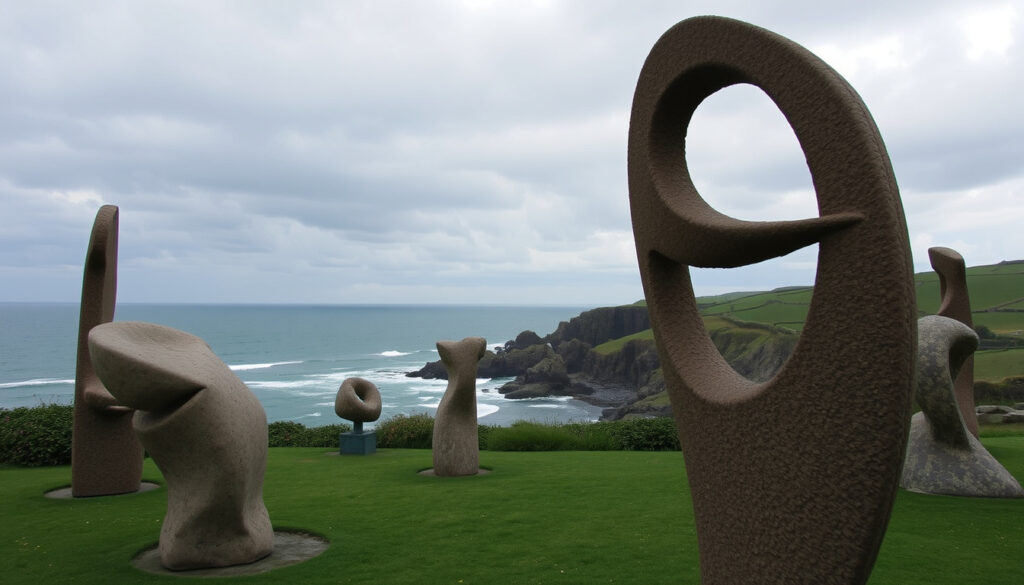
Barbara Hepworth – Life, Death, and the Museum in St Ives
Dame Barbara Hepworth, born on 10 January 1903 in Wakefield, Yorkshire, is celebrated as one of the most important British sculptors of the 20th century. Her pioneering work in abstract and modernist sculpture, defined by organic forms and a radical technique of piercing the block, reshaped the language of art. For those seeking to understand her enduring legacy, this guide covers her life, groundbreaking artwork, the circumstances of her death, and the museums that preserve her work.
Who Was Barbara Hepworth? A Life in Sculpture
- Barbara Hepworth remains one of the most influential modernist sculptors of the 20th century.
- Her work is defined by abstract organic forms and a deep connection to landscape, particularly Cornwall.
- The Barbara Hepworth Museum in St Ives offers the definitive collection of her work in its original setting.
- Her personal life (marriage to Ben Nicholson, triplets) significantly shaped her artistic output and legacy.
| Fact | Detail |
|---|---|
| Birth: | Wakefield, West Yorkshire, England, 1903 |
| Education: | Leeds School of Art, Royal College of Art |
| Signature Work: | Single Form (United Nations), Pelagos |
| Death: | Fire at her studio in St Ives, 20 May 1975, aged 72 |
| Legacy: | Barbara Hepworth Museum (Tate), The Hepworth Wakefield |
Early Life and Education
Born into a middle-class family in Wakefield, her father Herbert Hepworth was a County Surveyor and Alderman. From childhood, she was fascinated by natural forms and decided at age 15 to become a sculptor. She studied at Leeds School of Art from 1920 to 1921, and on a scholarship, at the Royal College of Art in London from 1921 to 1924. It was there she met fellow artists Henry Moore and Naum Gabo (Wikipedia; Tate).
The Shift to Abstraction
Her early representational work evolved into geometric and abstract forms by the early 1930s. She and her husband Ben Nicholson revealed this shift in joint exhibitions in 1932 and 1933. She became a member of the Abstraction-Création group, moving decisively away from figurative representation (Pace Gallery).
How Did Barbara Hepworth Die?
Barbara Hepworth died on 20 May 1975 at the age of 72 in St Ives. She died in a fire at her studio and home, Trewyn Studios, after a long battle with cancer. The fire destroyed much of her studio space (Wikipedia; Britannica).
The exact cause of the 1975 fire remains officially undetermined, but it is not considered suspicious by major sources. This tragic event cut short the life of a sculptor who was still actively creating.
What Inspired Barbara Hepworth’s Groundbreaking Artwork?
Hepworth and Henry Moore were fundamental in establishing the vocabulary of modern British sculpture, championing “truth to materials.” Her work responded to the physical characteristics of the material chosen rather than forcing it into a pre-determined shape (The Art Story).
Stringed Sculptures and Pelagos
In August 1939, she began creating stringed sculptures, a style that became iconic to her later career. Pelagos (1946), named after the Greek word for “sea,” is a large limestone sculpture featuring pierced holes that allow light to pass through, reflecting her deep connection to the Cornish landscape (Hepworth Wakefield).
Her works often maintain a visual affinity with the human form while being purely abstract. Pieces like Pierced Hemisphere I and Two Forms are examples of her shift toward geometric abstraction (Hepworth Wakefield).
The Barbara Hepworth Museum: Location and Legacy
The Barbara Hepworth Museum is in St Ives, Cornwall, housed in her former studio and garden. The studio was designated the museum in 1976. It came under the Tate’s aegis in 1980 and now secures an unrivalled collection of her work. Her home and garden are preserved as the Barbara Hepworth Home and Sculpture Garden, run by the Tate St Ives (Tate). Her former Palais de Danse studio is being restored to recreate her workshop spaces (Lund Humphries).
Connection to the Courtauld and Other Institutions
The Courtauld Institute of Art in London holds archival materials related to Hepworth and has hosted exhibitions on her work, particularly focusing on her early influence and modernism. Her death marked the final passing of St Ives’s moment as a centre of avant-garde art in Britain.
Beyond the Studio: Barbara Hepworth’s Family and Personal Life
In 1934, Hepworth and Nicholson gave birth to triplets: Paul, John, and Sarah. Hepworth later noted that after this event, her work became “more formal,” with all traces of naturalism disappearing, as she focused intensely on spatial relationships. In 1939, due to the threat of World War II bombings, the family moved to St Ives, where she remained for the rest of her life. Her work was significantly interrupted in 1953 when her son Paul was killed in a Royal Air Force plane crash over Thailand.
Was Barbara Hepworth Related to Barbara Ferris?
There is no credible evidence that Barbara Hepworth was related to the actress Barbara Ferris. Such claims are unfounded and not supported by official estate records.
What about Martha Hepworth?
She also adopted a daughter named Martha as a teenager. Information regarding Martha Hepworth’s remarriage is poorly sourced; official estate records are the most reliable.
Timeline of a Life in Art
- 1903: Born in Wakefield, Yorkshire
- 1920-1923: Trained at Leeds School of Art and Royal College of Art
- 1931: Marries sculptor Ben Nicholson
- 1934: Gives birth to triplets (Rachel, Sarah, Simon)
- 1939: Moves to St Ives, Cornwall; pivotal landscape inspiration
- 1950: Appointed CBE; later DBE in 1965
- 1975: Dies in a fire at her Trewyn Studio, St Ives
Certainty and Uncertainty in Hepworth’s Biography
| Established Information | Information That Remains Unclear |
|---|---|
| Barbara Hepworth died in a studio fire on 20 May 1975; this is universally confirmed by official sources (Tate, Hepworth Estate). | There is no credible evidence that Barbara Hepworth was related to the actress Barbara Ferris. |
| Her triplets Rachel, Sarah, and Simon are well-documented in biographies and public records. | Rumor regarding her daughter Martha Hepworth’s remarriage is poorly sourced; official estate records are the most reliable. |
| She was a pioneering modernist sculptor who championed “truth to materials.” | The exact cause of the 1975 fire remains officially undetermined but is not considered suspicious by major sources. |
The Broader Context: Her Place in Modern Art
Barbara Hepworth’s abstract style evolved alongside contemporaries Henry Moore and Ben Nicholson. Post-war Britain saw her work gain international recognition, culminating in major commissions like the United Nations’ Single Form in 1964. The creation of the Barbara Hepworth Museum in 1976 cemented her status as a national treasure. Her work Pelagos (1946) directly reflects the fusion of landscape and abstraction that defines her legacy.
Sources and Words on Hepworth
“I am a sculptor because I use my hands and my eyes.”
— Barbara Hepworth Estate / barbarahepworth.org.uk
“Her work exemplifies Modernism and in particular modern sculpture.”
— Tate Museum, St Ives
“She is one of the most important artists of the 20th century.”
— Hepworth Wakefield
Summary: The Enduring Legacy of Barbara Hepworth
Barbara Hepworth remains one of the most influential sculptors of the mid-20th century, whose lyrical forms and deep sensitivity to material transformed modernist sculpture. Her pioneering work in abstraction, mastery of carving, and revolutionary use of space continue to inspire. To see her work in its original setting, visit the Visit Tate St Ives: Barbara Hepworth Museum.
Frequently Asked Questions
What is the Barbara Hepworth museum?
The Barbara Hepworth Museum is a dedicated museum in St Ives, Cornwall, housed in her former studio and garden. It is managed by the Tate and contains a permanent collection of her sculptures and works.
Are there good books on Barbara Hepworth?
Yes. Authoritative options include ‘Barbara Hepworth: A Life of Forms’ and the official biography published by the Hepworth Estate. The Tate also produces exhibition catalogues.
Did Barbara Hepworth have children?
Yes. She had triplets in 1934: Rachel, Sarah, and Simon, with her second husband Ben Nicholson. She also adopted a daughter, Martha, as a teenager.
What is the connection between Barbara Hepworth and the Courtauld?
The Courtauld Institute of Art in London holds archival materials related to Hepworth and has hosted exhibitions on her work, particularly focusing on her early influence and modernism.
What is the work ‘Pelagos’?
‘Pelagos’ (1946) is one of Hepworth’s most famous abstract wooden sculptures. Its title means ‘sea’ in Greek, and it reflects her deep connection to the Cornish coastline.
What was Barbara Hepworth known for?
She was known for pioneering modernist and abstract sculpture, championing “truth to materials,” and her technique of piercing the block to explore space and form.
Where did Barbara Hepworth live?
She lived in St Ives, Cornwall, from 1939 until her death in 1975. Her home and studio are now the Barbara Hepworth Museum and Sculpture Garden.
More related posts
 Alex Jones – Conspiracy Theorist, Sandy Hook Lawsuits and Bankruptcy 2025
 Adam Brody – Biography, Wife, Kids and Net Worth
 Susan Wokoma – Biography, Career, and Personal Life
 Alexander Bublik – ATP Ranking, Career Stats and Biography 2026
 When Does Premier League Start – 2025/26 and 2026/27 Dates Confirmed
 Ginevra Weasley – Full Biography, Actor, Relationships and Facts
 Bose Headphones – UK 2025 Buying Guide and Comparison
 Jade Traitors – Biography, Education and Family Background
