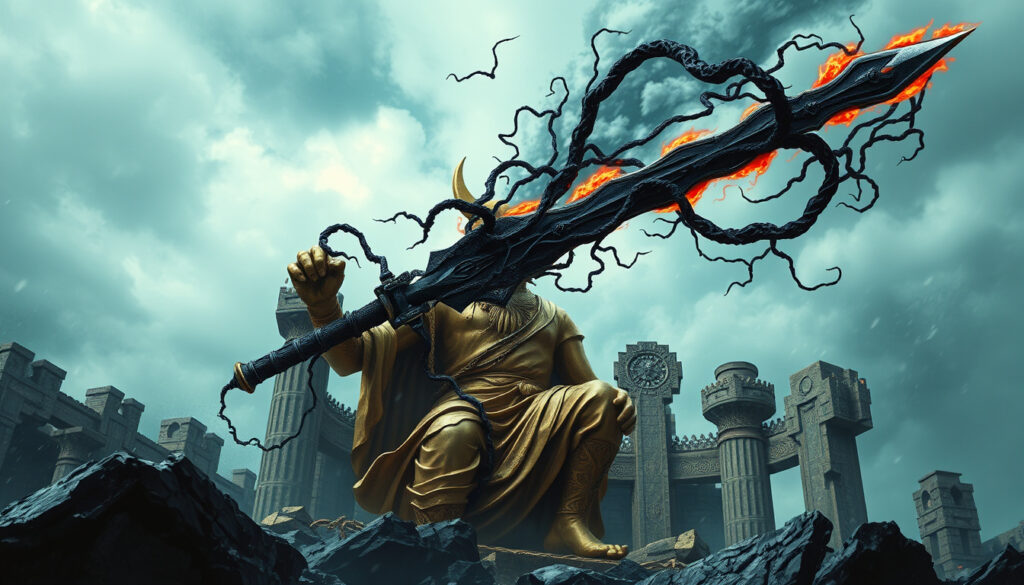
Gorr the God Butcher – Origin Powers Necrosword Explained
Gorr the God Butcher stands as one of Marvel’s most compelling and terrifying villains—a being whose existence challenges everything Thor holds sacred. Created by writer Jason Aaron and artist Esad Ribić, Gorr first appeared in Thor: God of Thunder #2 in 2012, quickly establishing himself as a villain unlike any other Thor had faced. His mission was simple yet apocalyptic in scope: the extinction of all gods throughout the universe.
What makes Gorr particularly haunting is not merely his extraordinary power, but the deeply human tragedy that drives his crusade. His journey from devoted believer to god-slayer represents one of Marvel’s most nuanced explorations of faith, loss, and vengeance. The character’s impact extends beyond the comics into the Marvel Cinematic Universe, where Christian Bale brought this dark figure to life in Thor: Love and Thunder.
This comprehensive examination traces Gorr’s origins, his terrifying powers, his encounters with Thor across time, and how the character was adapted for the screen.
Who is Gorr the God Butcher?
Key Insights
- Gorr’s hatred stems from gods abandoning his family on his famine-stricken home planet
- The Necrosword bonds with him symbiote-like, amplifying his god-killing abilities
- The MCU version significantly alters his origin compared to the source material
- His shadow monster army allows systematic elimination of divine beings across the cosmos
- Gorr influenced major storylines including Thor’s loss of his hammer-wielding ability
- The character represents one of Thor’s most philosophical and personal threats
Quick Facts
| Fact | Details |
|---|---|
| Real Name | Gorr |
| Species | Alien (unrevealed planet) |
| First Appearance | Thor: God of Thunder #2 (October 2012) |
| Primary Affiliation | God Butcher |
| Comic Status | Deceased |
| Primary Weapon | All-Black the Necrosword |
| Notable Conflict | God Butcher Trilogy (2012-2014) |
| MCU Debut | Thor: Love and Thunder (2022) |
What is Gorr’s Backstory and Origin?
Gorr emerged from a religious culture on a planet ravaged by famine and poverty. Originally a devout and peaceful man, his life changed forever when tragedy struck his family. The death of his daughter shattered his faith completely, leaving him broken and wishing for death. This devastating loss transformed his once-absolute devotion into searing rage against the divine beings he had once worshipped.
The breaking point came when the gods of his world belittled his suffering and never intervened to help those in need—including his dying family. Their indifference to mortal pain became the foundation of Gorr’s unforgiving hatred. He had prayed to them, trusted them, and they had done nothing. This betrayal by beings who claimed to be worthy of worship became the catalyst for his future crusade.
How Gorr Obtained the Necrosword
At his lowest point, Gorr witnessed an extraordinary event that would define his existence: he observed Knull in combat with a golden god. During this confrontation, the All-Black the Necrosword appeared before him. The weapon’s arrival proved transformative in ways Gorr could never have anticipated.
When Gorr was nearly sacrificed by the god Rapu, the shadow cast by both figures allowed the Necrosword to rise into his hands. The weapon spoke to him, instructing him to find Eternity using a Bifrost Bridge for revenge against the gods who had abandoned him. Rapu explained that the Necrosword had chosen Gorr and that he would be cursed by it. Gorr’s response became legendary: “It doesn’t feel like a curse… it feels like a promise.” He then beheaded Rapu as his first victim, beginning his eternal campaign.
The MCU version of Gorr’s origin in Thor: Love and Thunder differs significantly from the comics. The film condenses and alters several elements for narrative pacing, including how he acquires the Necrosword and his motivation for targeting Thor specifically rather than gods randomly.
What Are Gorr’s Powers and the Necrosword?
All-Black the Necrosword Explained
The All-Black the Necrosword serves as the source of Gorr’s extraordinary power and represents one of the most significant weapons in Marvel’s cosmic mythology. This ancient blade exists in the Marvel Universe as something far more than a conventional weapon—it functions almost as a living entity with its own consciousness and agenda.
The Necrosword physically transformed Gorr upon their bonding. It granted him the ability to instantly heal wounds, allowing him to survive injuries that would kill any mortal being. Beyond physical regeneration, the weapon provided Gorr with dark magical capabilities that amplified his already considerable combat skills and allowed him to challenge beings of immense power.
Perhaps most significantly, the Necrosword extended Gorr’s lifespan dramatically, keeping him alive for eons. Over countless millennia, he became more of a dark god himself as he and the weapon merged into a single entity. This symbiosis transformed both Gorr and the Necrosword, making them virtually inseparable and creating a being that existed beyond normal mortal limitations.
Shadow Monster Army
With the Necrosword’s help, Gorr created an army of Shadow Monsters—also called Black Berserkers or shadow berserkers. These warriors were made entirely from the weapon’s substance, appearing as large armored figures wielding battle axes and swords. These constructs allowed Gorr to systematically eliminate gods across the universe without direct confrontation in every instance.
The shadow berserkers represented an extension of Gorr’s will, operating as extensions of his power across vast distances. Through these servants, Gorr could conduct his divine genocide across multiple worlds simultaneously, making his campaign against the gods far more efficient than any direct assault could achieve.
The Necrosword connects to Knull, the symbiote god, establishing important continuity within the Marvel Universe. This connection hints at deeper mythological roots for the weapon and its origins, linking Gorr’s story to broader cosmic events involving the symbiote species.
Gorr in Thor: Love and Thunder
Christian Bale portrayed Gorr the God Butcher in Thor: Love and Thunder, bringing the character’s terrifying presence to the Marvel Cinematic Universe. The film, directed by Taika Waititi, introduced audiences to this nihilistic villain whose god-killing mission posed an existential threat to the MCU’s divine beings.
MCU Adaptation Differences
The MCU version of Gorr’s origin differs significantly from the comics. In the film, Gorr begins his god-killing campaign specifically to draw Thor’s attention. His ultimate goal involves stealing Stormbreaker—Thor’s mystical ax necessary for summoning the Bifrost to meet Eternity, a powerful cosmic entity.
To accomplish this, Gorr kidnapped the children of New Asgard to lure Thor into confrontation. This represents a notable departure from the comics, where Gorr engaged in random slaughter of gods until his first encounter with young Thor forced him to adopt a more strategic approach. The film condenses this development for pacing purposes.
While the film captures Gorr’s essential character and motivation, several comic elements were simplified or altered. Those familiar with the source material may notice differences in the Necrosword’s acquisition, the character’s lifespan, and specific plot points regarding his encounters with various gods.
Gorr’s Role in the Comics
Gorr the God Butcher stands as one of Marvel’s most compelling and terrifying villains—a being whose existence challenges everything Thor holds sacred. Created by writer Jason Aaron and artist Esad Ribić, Gorr first appeared in Thor: God of Thunder #2 in 2012, quickly establishing himself as a villain unlike any other Thor had faced. His mission was simple yet apocalyptic in scope: the extinction of all gods throughout the universe.
What makes Gorr particularly haunting is not merely his extraordinary power, but the deeply human tragedy that drives his crusade. His journey from devoted believer to god-slayer represents one of Marvel’s most nuanced explorations of faith, loss, and vengeance. The character’s impact extends beyond the comics into the Marvel Cinematic Universe, where Christian Bale brought this dark figure to life in Thor: Love and Thunder.
First Appearance and God Butcher Trilogy
Gorr made his comic debut in Thor: God of Thunder #2 in 2012, quickly becoming established as one of Thor’s most formidable adversaries. His storyline, known as the “God Butcher Trilogy,” spanned issues that explored his campaign across different time periods, including his original conflict with Thor in the distant past.
Encounters with Thor Through Time
Gorr’s campaign began by traveling the cosmos through the Shadow Realm, slaughtering any gods he could find. His first encounter with Thor occurred on Earth in Medieval Iceland in 893 A.D. During this confrontation, Gorr nearly killed the young Thor Odinson, but a band of Vikings assisted Thor and helped him escape—though not before losing his arm in the battle. For more details on Gorr the God Butcher’s comic origins and his “God Butcher Trilogy,” visit boersenblicker.de.
Realizing he couldn’t overcome Thor through direct confrontation due to Thor’s sheer willpower and power, Gorr pivoted his strategy. He focused on killing other gods first while building his shadow berserker army, creating a more methodical approach to his divine genocide.
The God Butcher Trilogy’s Climax
In the present-day storyline, Thor investigated the mysterious disappearances of gods and eventually confronted Gorr. During a critical moment, when Gorr killed his wife for calling him a god, his “son”—actually a construct made from the All-Black Necrosword itself—released Thor from captivity and asked him to kill Gorr. The construct observed that the man Gorr once was would be horrified at what he had become.
Gorr’s ultimate goal was to reach Eternity by opening the Gates of Eternity with a Bifrost Bridge so he could grant his wish to bring about the extinction of all gods. In his campaign, he killed the Sky Lords of Indigarr, leaving that planet unprotected and vulnerable to invasion.
Chronology of Gorr’s Story
Understanding Gorr’s narrative requires examining the timeline of his appearances and key events across Marvel continuity.
- Prehistoric Era: Gorr witnesses the failures of gods on his home planet and experiences the tragedies that shatter his faith
- 2012: First appearance in Thor: God of Thunder #2, debuting the God Butcher storyline
- 893 A.D.: First encounter with Thor Odinson in Medieval Iceland, resulting in Thor’s near-death and arm loss
- Present Day: Thor investigates disappearing gods and confronts Gorr in the main storyline
- King Thor Era: Final confrontation between an aged Thor and Gorr millions of years in the future
- Original Sin: Gorr’s legacy influences Thor’s loss of his hammer-wielding ability through Nick Fury’s whispered secret
- 2022: MCU debut in Thor: Love and Thunder, portrayed by Christian Bale
What is Certain and What Remains Unclear
When examining Gorr’s story, certain elements remain firmly established while others present ambiguities worth noting.
| Established Information | Uncertain or Unclear |
|---|---|
| Gorr is an alien from an unrevealed planet who lost his faith after his daughter’s death | Specific details about his home planet’s location and name remain officially unrevealed |
| Christian Bale portrayed him in Thor: Love and Thunder | Whether Bale will return for future MCU projects remains unconfirmed |
| The Necrosword connects to Knull and the symbiote mythology | Full extent of symbiote connections in future storylines is unknown |
| Gorr kidnapped New Asgard’s children in the MCU to lure Thor | Potential comic crossovers with Venom or Knull remain speculative |
| All details from official Marvel publications and authorized sources | Rumored appearances in symbiote storylines have not been officially confirmed |
The Themes Behind Gorr’s Mission
Gorr represents more than a typical comic book villain—he embodies a philosophical critique of divine intervention and the problem of suffering. His central argument, that gods who do nothing in the face of mortal pain deserve annihilation, presents a disturbing but coherent worldview that challenges readers to consider uncomfortable questions about faith and responsibility.
The character’s nihilism stems from genuine grievance. He was not born evil but was created through tragedy and betrayal by beings he trusted. This origin makes him sympathetic despite his monstrous actions, creating a morally complex antagonist whose motivations demand consideration even as his methods remain indefensible.
Gorr’s existence forced Marvel to explore deeper theological questions within the Thor mythology. His storyline examined what happens when divine beings abandon their responsibilities, presenting consequences that resonate beyond typical superhero narratives.
Sources and Notable Quotes
“I am Butcher of Gods!” — Gorr, Marvel Comics
“Gorr embodies ultimate blasphemy.” — Jason Aaron, Thor: God of Thunder writer
The information in this article draws from official Marvel publications including Thor: God of Thunder Vol 1, authorized databases such as the Marvel Cinematic Universe Wiki and Marvel Fandom, and statements from the character’s creators. Key sources include Wikipedia’s documented entries on Gorr the God Butcher and Jason Aaron’s official Substack communications regarding the character’s development.
Additional authoritative sources include Screen Rant’s analysis of the character’s comic-to-film adaptation differences and the Marvel Official Database, all of which provide verified information about Gorr’s storyline, powers, and significance within the Marvel Universe.
Summary
Gorr the God Butcher stands as one of Marvel’s most significant villains—a character whose impact reaches across both comics and the Marvel Cinematic Universe. Created by Jason Aaron and Esad Ribić, he represents a unique threat to Thor not through physical power alone, but through the philosophical challenge he poses to the very concept of divine worthiness.
From his tragic origins on a suffering world to his acquisition of the All-Black the Necrosword, Gorr’s journey from devoted believer to god-slayer creates one of Marvel’s most compelling villain arcs. His influence extends beyond his direct appearances, affecting Thor’s character development and forcing difficult questions about faith, justice, and the responsibilities of power.
Whether encountered in the pages of Thor: God of Thunder or on screen in Thor: Love and Thunder, Gorr remains a testament to how comic book villains can serve as vehicles for meaningful exploration of belief, loss, and the consequences of institutional failure. For those interested in related content, readers may also explore streaming guides for other Marvel content or discover entertainment-related deals.
Frequently Asked Questions
What happens to Gorr in the comics?
Gorr meets his end in the God Butcher Trilogy when his own shadow creature—an entity created from the Necrosword—releases Thor and begs him to end Gorr’s reign. Thor ultimately defeats him, though Gorr is later resurrected by Loki millions of years in the future before being finally depowered and sent to live out his mortal life on Indigarr.
Gorr vs Thor: Who wins?
In their various encounters, the outcome varies by storyline. In their first encounter in 893 A.D., Thor barely survives and loses his arm. In the present-day storyline, Thor ultimately defeats Gorr with help from Gorr’s own shadow construct. The outcome depends on which era and specific storyline is being referenced.
Is the Necrosword related to symbiotes?
Yes, the All-Black the Necrosword connects to Knull, the symbiote god. This connection establishes the weapon as part of the broader symbiote mythology within Marvel’s cosmic landscape, though the exact nature of this relationship continues to develop in current storylines.
When was Gorr’s first appearance?
Gorr made his first appearance in Thor: God of Thunder #2, published in October 2012 (sometimes dated January 2013). The storyline ran through 2014 and is commonly referred to as the “God Butcher Trilogy.”
How did Gorr die in the comics?
Gorr was defeated when his own creation—a shadow creature spawned from the Necrosword—turned against him. This construct, who had become Gorr’s “son,” freed Thor and urged him to end the god butcher, observing that the man Gorr once was would be horrified at what he had become.
Why does Thor say “Gorr was right”?
Following the Original Sin storyline, Nick Fury whispered a secret to Thor that caused him to lose his hammer-wielding ability. After months of torment, Thor revealed to Beta Ray Bill that the secret was “Gorr was right”—meaning he believed the universe would have been better without gods. Beta Ray Bill countered that Thor’s continued fight for others even without his hammer proved he was more than merely a god.
Will Gorr appear in future MCU films?
While the character was introduced in Thor: Love and Thunder, no official announcements have confirmed his return. Rumors suggest potential appearances in symbiote-related storylines given the Necrosword’s connection to Knull, but these remain unconfirmed by Marvel Studios.
More related posts
 Selena Quintanilla – Her Tragic Death and Enduring Legacy
 James Van Der Beek – Cause of Death, Family and Career
 Harrods Advent Calendar 2025 – Price, Contents and Value Guide
 Nearest Gym to Me – Compare UK Gym Chains for 2025
 Nizoral Anti-Dandruff Shampoo – Proven Treatment Guide
 Cast of Top Gun 2 – Full List Actors and Characters
 Jade Thirlwall – Bio, Age, Net Worth, and Relationship
 Best Loan Rates UK – Top Deals For Every Amount
