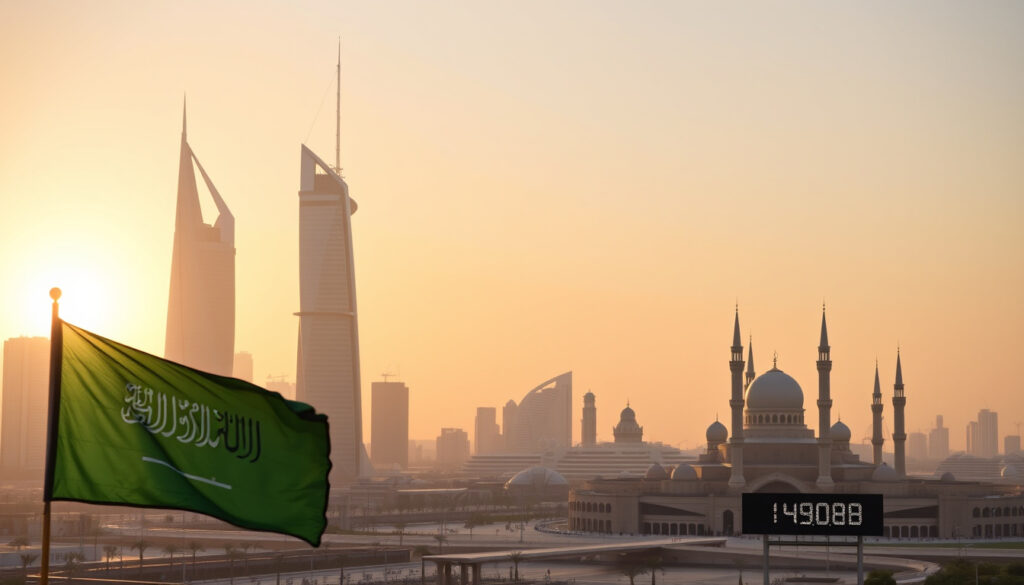
Saudi Arabia – Capital, Currency, Prayer Times and Key Facts
Saudi Arabia, officially the Kingdom of Saudi Arabia, is a country that has undergone significant transformation in recent years. From its capital Riyadh to its ambitious Vision 2030 projects, the kingdom balances religious heritage with modernization. This guide provides key facts about the country’s geography, culture, and leadership.
The country’s currency is the Saudi riyal (SAR), and it operates on Arabia Standard Time (UTC+3) with no daylight saving. Prayer times, based on the five daily Islamic prayers, shape daily life, though recent reforms have allowed businesses to remain open during prayer windows. Tourism is expanding and mega-projects like NEOM are underway, making understanding Saudi Arabia’s core information essential for travelers, business visitors, and those curious about its evolving identity.
What is the capital of Saudi Arabia?
Key insights about Saudi Arabia
- Saudi Arabia is undergoing a massive transformation under Vision 2030, led by Crown Prince Mohammed bin Salman, with projects like NEOM reshaping its economy and tourism.
- Islamic practices heavily influence daily life, reflected in high search volume for prayer times and Islamic dates.
- Travel to Saudi Arabia has opened up significantly since 2019 with the introduction of tourist visas, boosting interest in attractions like Mecca, Riyadh, and the Red Sea coast.
- The country remains the world’s largest oil exporter, but diversification efforts are accelerating under Vision 2030.
- Recent reforms have allowed shops and businesses to remain open during prayer times, ending a decades-old mandatory closure rule.
Essential Saudi Arabia facts
| Category | Detail |
|---|---|
| Capital | Riyadh |
| Population (est. 2025) | ~35 million |
| Government | Unitary Islamic absolute monarchy |
| King | Salman bin Abdulaziz Al Saud |
| Crown Prince | Mohammed bin Salman |
| Official Language | Arabic |
| Currency | Saudi Riyal (SAR) – pegged to USD (1 USD ≈ 3.75 SAR) |
| Time Zone | Arabia Standard Time (UTC+3) |
| Telephone Code | +966 |
| Internet TLD | .sa |
What are the daily prayer times in Saudi Arabia?
Prayer times in Saudi Arabia are based on the five daily Islamic prayers—Fajr, Dhuhr, Asr, Maghrib, and Isha—and they vary by location and date. The timings are tied to the sun’s position and local geography, so schedules can differ slightly by city.
What is Maghrib time in Saudi Arabia?
Maghrib prayer time is the sunset prayer and changes daily. Visitors can check local schedules using Islamic apps or official sources like the Umm al-Qura Calendar, which is based on Makkah calculations.
What is Asr time in Saudi Arabia?
Asr is the afternoon prayer, and its timing also shifts daily. As with all prayers, accurate times are widely available through mobile apps and websites that synchronize with Saudi Arabia’s official calendar.
What is the Islamic date today in Saudi Arabia?
The Islamic (Hijri) date is published daily by the official Umm al-Qura calendar. Many Islamic apps and websites synchronize with Saudi time to provide the current date.
Saudi prayer times change daily because they depend on the sun’s position. The standard set is Fajr, Dhuhr, Asr, Maghrib, and Isha. Prayer schedules can differ slightly by city because of geography.
Who is the Crown Prince of Saudi Arabia?
Mohammed bin Salman is the Crown Prince and de facto leader of Saudi Arabia. He has driven major social and economic reforms under Vision 2030, the kingdom’s ambitious plan to reduce dependence on oil and modernize the economy.
What is NEOM in Saudi Arabia?
NEOM is a flagship national development project tied to Vision 2030. It is a planned mega-city under construction, associated with modernization and diversification. King Salman has been reported performing Eid prayer there, linking the project to high-profile state events.
The crown prince has used economic and social reforms to reduce dependence on oil and change the kingdom’s image. Tourism is part of the broader reform push to diversify the economy away from oil and attract foreign talent and investment.
What is Saudi Arabia Airlines (Saudia)?
Saudi Arabia’s national airline is officially called Saudia (formerly Saudi Arabian Airlines). It facilitates travel for pilgrims, tourists, and business visitors. The airline operates from its hub in Jeddah and connects the kingdom globally.
What is traditional Saudi Arabian food?
Details on Saudi Arabian cuisine are not covered in the available information. Traditional dishes such as kabsa (spiced rice with meat) and mutabbaq (stuffed pastry) are commonly cited in broader cultural references, but authoritative verification from official culinary resources is recommended for readers seeking specifics.
How is the Saudi Arabia national football team performing?
Verified details on the Saudi national football team’s schedule are not available; match schedules vary by season. For current information, fans should consult official FIFA or AFC calendars for the Green Falcons and domestic league fixtures.
What are the 99 names of Allah?
The 99 names (Asma ul-Husna) are attributes of God in Islam, widely recited and memorized. They hold deep religious significance in Saudi Arabia as the birthplace of Islam. Many Muslims in the kingdom incorporate them into daily prayers and spiritual practice.
Coverage of Saudi food, football, and airlines is limited in the available information. Readers should consult dedicated guides or official sources for comprehensive details on these topics.
What are the top tourist attractions in Saudi Arabia?
Riyadh
Riyadh is the capital and a major hub for business, culture, and tourism. It features modern landmarks, traditional souks, and historical sites. The city is a gateway for exploring the kingdom’s heritage and contemporary development.
Mecca
Mecca is the holiest city in Islam, visited by millions of pilgrims each year for Hajj and Umrah. The city is central to Islamic faith and attracts visitors from around the world. Access is restricted to Muslims.
NEOM
NEOM is a planned mega-city under construction on the Red Sea coast. It is a flagship project of Vision 2030, representing a futuristic approach to urban living, sustainability, and technology. Tourism infrastructure is being developed as part of the project.
Since 2019, Saudi Arabia has issued tourist visas, opening the country to international visitors. The tourism sector is a key pillar of economic diversification, promoting cultural sites, natural landscapes, and modern attractions.
Key historical milestones in Saudi Arabia’s development
- 1932 – Unification of the Kingdom of Saudi Arabia under King Abdulaziz Al Saud.
- 1938 – Discovery of oil in the Eastern Province.
- 1960s–70s – Oil boom transforms economy and infrastructure.
- 2005 – King Abdullah accedes; initiates reforms.
- 2015 – King Salman becomes king; Mohammed bin Salman named crown prince in 2017.
- 2016 – Announcement of Vision 2030 and NEOM.
- 2019 – Opening to international tourism; first tourist visas issued.
- 2023 – Hosting of major events (e.g., 2029 Asian Winter Games bid, football investments).
What is known and what remains uncertain?
| Established information | Information that remains unclear |
|---|---|
| Riyadh is the capital and government seat. | Exact completion timeline for NEOM and other Vision 2030 projects. |
| The official currency is the Saudi Riyal. | Future population figures due to rapid demographic changes. |
| Prayer times follow a fixed schedule published daily by the government. | Specific dates for upcoming football matches may change. |
| Mohammed bin Salman is the current Crown Prince and de facto ruler. | Exchange rates fluctuate daily, though the peg to USD is stable. |
| NEOM is a planned mega-city under construction. | Detailed traditional food recipes and restaurant guides. |
Understanding Saudi Arabia’s modern transformation
Saudi Arabia balances religious heritage with modernisation efforts. High search volumes for prayer times and Islamic dates reflect the central role of Islam in daily life. The country’s geopolitical influence, oil wealth, and mega-projects like NEOM drive international interest, while controversies around human rights and the Yemen war add complexity.
Tourism growth is a key pillar: Visit Saudi promotes cultural sites, and the national airline Saudia facilitates travel. Sports, especially football, are a rising soft power tool, with the national team and club investments boosting global engagement.
Key sources for Saudi Arabia information
- Wikipedia – Saudi Arabia – Basic facts, history, government structure.
- Britannica – Saudi Arabia – Authoritative geography, economy, culture.
- Visit Saudi Official Tourism – Travel attractions, visas, events.
- Saudia (Saudi Airlines) – Cultural overview, travel logistics.
- Saudi Central Bank – Currency and financial information.
Summary: Saudi Arabia at a crossroads
Saudi Arabia is a country in flux: rooted in Islamic tradition yet racing toward a diversified, modern future. Key developments to watch include the progress of NEOM, changes to visa policies and tourism infrastructure, the national football team’s calendar, and adjustments to Vision 2030 targets and economic reforms. For ongoing updates, consult trusted news outlets and official government channels. For related financial context, see Gold Rate in Pakistan Today – 24K and 22K Live Prices Per Tola.
Frequently asked questions
What is the Saudi Arabia Airlines called?
Saudi Arabia’s national airline is officially called Saudia (formerly Saudi Arabian Airlines).
When is the next Saudi Arabia match? (football)
Match schedules vary by season; check official FIFA or AFC calendars for the Saudi national team (Green Falcons) or club fixtures.
What are the 99 names of Allah?
The 99 names (Asma ul-Husna) are attributes of God in Islam, widely recited and memorized; they hold deep religious significance in Saudi Arabia as the birthplace of Islam.
How can I find the Islamic date in Saudi Arabia?
The Islamic (Hijri) date is published daily by the official Umm al-Qura calendar; many Islamic apps and websites synchronise with Saudi time.
What is the current time in Saudi Arabia?
Saudi Arabia is in the Arabia Standard Time zone (UTC+3), which does not observe daylight saving time.
What is the population of Saudi Arabia?
Estimated at around 35 million as of 2025.
What is the currency of Saudi Arabia?
The Saudi riyal (SAR), pegged to the US dollar at approximately 3.75 SAR per USD.
What is the national day of Saudi Arabia?
September 23, commemorating the unification of the kingdom in 1932.
What is Vision 2030?
An ambitious reform plan to diversify the economy, reduce oil dependence, and modernize society, launched in 2016.
Is Saudi Arabia safe for tourists?
Saudi Arabia has made significant investments in tourism infrastructure and safety; visitors are advised to follow local laws and customs.
More related posts
 Peter Townsend – Battle of Britain Ace and Royal Romance
 Convert Kilos to Stones – Precise Formulas and Tables
 Kieron Moore – Age, Career, Vampire Academy and Boxer Background
 Polar Bear – Complete Guide to Size, Diet and Conservation
 Fashion Nova – Shopping Guide for 2025 and Beyond
 Size 39 in UK – Complete Shoe Size Guide for Women and Men
 Tammy Abraham – Profile, Stats, Injury and Career Timeline
 Shirley Temple – Biography, Movies, and the Cocktail Recipe
