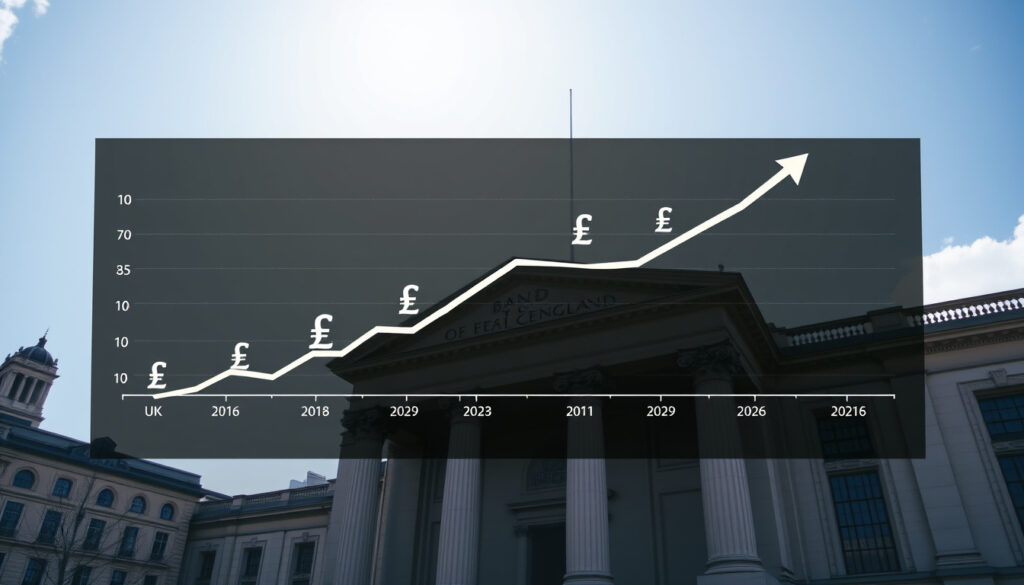
Interest Rate Predictions UK – Forecasts for 2026 and Beyond
The Bank of England base rate currently stands at 3.75%, with markets and economists closely monitoring how global pressures will shape borrowing costs through 2026 and beyond. Geopolitical developments in the Middle East have introduced fresh uncertainty into inflation forecasts, prompting a recalibration of expectations for the year ahead.
Interest rate decisions directly affect millions of mortgage holders, savers, and businesses across the United Kingdom. Understanding the trajectory of the base rate requires examining both official projections from the Bank of England and market-based forecasts that reflect evolving economic conditions.
What is the next UK interest rate decision?
The next Monetary Policy Committee meeting is scheduled for 30 April 2026. Markets currently price in no change to the base rate at that meeting, with the Bank of England expected to hold rates at 3.75% through the remainder of 2026. The MPC convenes eight times annually, publishing meeting minutes and decisions shortly after each gathering.
The hold consensus reflects a significant shift from earlier expectations. Prior to escalating Middle East tensions, economists had priced in gradual cuts throughout 2026. The Iran-linked conflict has disrupted oil and gas supplies, pushing CPI inflation to 3.3% and delaying the anticipated return to the 2% target.
- The Bank of England has paused its easing cycle after delivering six consecutive rate cuts between 2024 and 2025.
- CPI inflation stands at 3.3%, well above the 2% target, primarily driven by energy price spikes stemming from Middle East instability.
- Markets have reversed prior expectations for cuts, with traders now pricing a hold or potential hikes if oil prices remain elevated.
- Public sentiment remains divided, with 23% expecting rate rises and 25% anticipating falls.
- The Bank projects inflation at 2.7% by Q4 2025, falling to 2.2% by Q4 2026 and 1.8% by 2027.
- Economists from Tembo, HOA, MoneyWeek, Fidelity, and Deutsche Bank have all revised their forecasts to favor a hold stance.
- Some analysts warn of sticky inflation remaining at 2.5%, complicating the outlook further.
| Metric | Current | 2026 Forecast | Source |
|---|---|---|---|
| Bank of England Base Rate | 3.75% | 3.75% | Bank of England |
| CPI Inflation | 3.3% | 2.2% (Q4 2026) | BoE projections |
| 2-Year Fixed Mortgage | 4.90% | 3.50%–4.50% | Market forecasts |
| 5-Year Fixed Mortgage | 4.50% | 4.00%–5.25% | Market forecasts |
| 10-Year Fixed Mortgage | 4.46% | 4.50%–5.75% | Market forecasts |
| 2-Year Variable Rate | 5.20% | 3.25%–4.50% | Market forecasts |
| 10-Year Gilt Yield | 4.129% | Variable | Bond markets |
| Previous Peak Rate | 5.25% | 2023–2024 | Historical data |
What is the UK interest rate forecast for 2026?
Forecasts for the remainder of 2026 cluster around the 3.75% level, with no clear consensus on direction. The primary driver of uncertainty remains geopolitical risk in the Middle East, where conflict involving Iran has repeatedly disrupted energy markets throughout early 2026.
Short-term rate expectations
Economists at Trading Economics project the base rate holding at 3.75% through the end of 2026. Their model incorporates the latest inflation data and central bank guidance to arrive at a stable outlook. HSBC and UBS had previously anticipated steeper declines toward 3%, but have since pulled back from those projections.
Pantheon Macroeconomics takes a different view, expecting rates to remain closer to 4% throughout 2026. Their analysis emphasizes persistent wage pressures and service sector inflation as factors that could keep the Bank of England cautious about further easing.
The reversal from expected cuts to holds reflects how quickly market consensus can shift. Investors who had priced in two or three reductions for 2026 have recalibrated their positions following the oil price surges triggered by Middle East tensions.
Inflation trajectory
The Bank of England’s own projections paint a cautiously optimistic picture. Official forecasts suggest inflation falling to 2.7% by Q4 2025, further declining to 2.2% by Q4 2026, before reaching 1.8% in 2027. However, the BoE acknowledges the risk of sticky inflation remaining elevated around 2.5% if energy prices prove more persistent than anticipated.
The December 2025 inflation reading stood at 3.4% when the BoE had originally forecast a return to 2% by spring 2026. That projection has now been pushed back, with analysts at HOA noting the conflict’s impact on energy markets as the primary cause of the delay.
What are interest rate predictions for the UK for the next 2–3 years?
The medium-term outlook for UK interest rates shows gradual decline as inflation returns to target. However, the path remains uneven, with significant divergence between forecasters on the precise timing and magnitude of cuts.
2027 projections
Oxford Economics anticipates the base rate falling to 2.5% by Q3 2027, with stability through 2029. Their model assumes disinflation resumes its course once energy market disruptions ease and wage growth moderates. Trading Economics offers a slightly higher estimate of 3.25% for 2027, reflecting more cautious assumptions about the speed of inflation’s return to target.
Deutsche Bank and Pantheon both project rates remaining elevated, at 3.75% to 4% into early 2027. Their forecasts incorporate scenarios where oil prices stay elevated or geopolitical tensions escalate further, potentially requiring the Bank of England to maintain a restrictive stance.
2028–2029 outlook
By 2028 and 2029, forecasts converge around the 2.5% to 3% range. Oxford Economics projects 2.5%, while Trading Economics estimates 3%. The Bank of England’s inflation targeting framework provides the anchor for these projections, assuming price pressures continue to moderate and the economy avoids significant shocks.
Econometric models used by institutions like Santander, HSBC, UBS, and Capital Economics typically assume inflation eases toward 2% under baseline scenarios. These models incorporate historical relationships between unemployment, wage growth, and price pressures but cannot account for unforeseen disruptions.
What are long-term interest rate predictions for the UK next 5 years and beyond?
Longer-term forecasts for the UK are inherently more uncertain. No unified consensus exists among economists for the five to ten year horizon, with different institutions applying varying assumptions about structural economic changes, productivity growth, and global conditions.
Most econometric models suggest stabilization around 2.5% to 3.25% over the longer term, assuming the Bank of England successfully returns inflation to target and maintains credibility. This would represent a significant decline from current levels but remains above the near-zero rates seen in the decade following the 2008 financial crisis.
Fidelity’s market insights highlight that wage pressures and global events will remain key determinants of the long-term outlook. Sustained tightness in labor markets could maintain structural upward pressure on rates, while technological change or productivity improvements might allow for lower equilibrium levels.
Interest rate predictions UK 2027
The year 2027 represents a pivotal transition point. Most forecasters expect the first meaningful reductions in the base rate since the current tightening cycle began. The precise level depends heavily on whether inflation falls closer to 2% or remains sticky around 2.5%.
UK interest rate forecast for next 10 years
Ten-year forecasts remain largely theoretical given the number of unknowns. Central bank models suggest rates normalizing around 2.5% to 3% under stable conditions, but demographic shifts, climate policy costs, and technological disruption could all alter the long-run equilibrium. Investors seeking higher rates should consider that historical patterns may not persist.
What are mortgage interest rate predictions in the UK?
Mortgage rates in the UK move in response to base rate changes and market expectations, but the relationship involves additional factors including swap rates, lender competition, and credit risk assessments. Fixed-rate mortgages dominate the UK market, with borrowers typically choosing two, three, five, or ten-year terms.
Fixed rate mortgage forecasts
The 2-year fixed mortgage rate averaged 4.90% in 2025 and is forecast to range between 3.50% and 4.50% in 2026. These rates track bond yields closely, with the 10-year gilt yield currently at 4.129% serving as a key reference point. As markets price in a hold at 3.75% through 2026, fixed rates have stabilized after the volatility of recent years.
3-year fixed rates averaged 4.09% in 2025 with forecasts for 2026 ranging from 3.75% to 5.00%. These products tend to be more vulnerable to market volatility than shorter-term options, making them attractive when borrowers expect rates to decline but uncertain when that decline will arrive.
Mortgage rate forecasts carry significant uncertainty. Steeper declines to 3% by end-2026 remain possible per HSBC and UBS projections, but Pantheon expects rates to hold near 4%. Borrowers should compare offers across multiple lenders and consider locking in rates when they find favorable terms.
5-year fixed rates averaged 4.50% in 2025 and are expected to range between 4.00% and 5.25% in 2026. These products offer more stability than 2-year deals, though borrowers pay a premium for the certainty of a longer rate lock. Those expecting rates to fall more sharply might prefer shorter terms, while risk-averse borrowers often favor the protection of five-year deals.
10-year fixed mortgages averaged 4.46% in 2025 with forecasts ranging from 4.50% to 5.75% for 2026. Despite higher headline rates, these products prove less volatile over their lifetime, making them suitable for borrowers seeking maximum predictability in their monthly payments.
Variable rate mortgage forecasts
2-year variable rate mortgages averaged 5.20% in 2025 and are forecast between 3.25% and 4.50% in 2026. These products move directly with the base rate, offering potential savings if the Bank of England delivers cuts. However, borrowers accept the risk of rising payments if conditions change unexpectedly. For those interested in exploring current options, you can mutui in Italia confronta offerte. mutui in Italia confronta offerte
Those seeking to maximize returns on savings while managing mortgage costs may explore High Interest Savings Account – Top UK Rates 2025 as a complement to their borrowing strategy. Similarly, High Interest Savings Accounts – Top UK Rates Up To 4.75% AER offer competitive returns for those with larger deposits.
Timeline of Bank of England interest rate decisions and expectations
Understanding the trajectory of UK interest rates requires examining both recent history and anticipated developments. The following timeline traces the path from the 5.25% peak through current levels and into the forecast period.
- 2023–2024: Base rate peaks at 5.25% as the Bank of England battles post-pandemic inflation with aggressive tightening.
- 2024–2025: Six consecutive rate cuts bring the base rate down to 3.75%, marking a significant shift in monetary policy.
- December 2025: CPI inflation stands at 3.4%, above expectations, as Middle East conflict disrupts energy markets.
- March 2026: Base rate holds at 3.75%, with inflation at 3.3%, significantly above the 2% target.
- 30 April 2026: Next scheduled MPC meeting, with markets pricing in no change to the base rate.
- Q4 2026: Bank of England projects inflation falling to 2.2%, supporting potential future cuts.
- 2027: Forecasts range from 2.5% (Oxford Economics) to 3.25% (Trading Economics) as inflation normalizes.
- 2028–2029: Rates expected to stabilize around 2.5% to 3% assuming disinflation continues.
- 5–10 years: Econometric models suggest stabilization between 2.5% and 3.25% under baseline assumptions.
The MPC meets eight times per year, typically on the first Thursday of the month. Meeting dates are published in advance on the Bank of England’s website, allowing borrowers and investors to plan accordingly.
What we know versus what remains unclear about UK interest rate predictions
Interest rate forecasting involves balancing established facts against genuine uncertainty. The following comparison highlights what analysts can say with confidence and what remains in doubt.
| Established information | Information that remains unclear |
|---|---|
| Current base rate: 3.75% | Exact timing of the first post-hold cut |
| Next meeting: 30 April 2026 | Whether rates will return to 2.5% or remain higher |
| CPI inflation at 3.3% | Severity of potential Middle East escalation |
| Bank projects 2.2% inflation by Q4 2026 | Long-term equilibrium rate (5–10 years) |
| Six cuts delivered 2024–2025 | Impact of wage growth on service sector inflation |
| Markets price no change for April 2026 | Whether Pantheon or Oxford forecasts prove accurate |
| 10-year gilt yield at 4.129% | Effect of global central bank policies on UK rates |
The divergence between forecasters reflects genuine uncertainty about energy prices, geopolitical developments, and the transmission of past rate increases through the economy. The Bank of England itself acknowledges multiple scenarios that could unfold depending on these factors.
Economic context and factors driving UK interest rate decisions
The Bank of England operates under a formal mandate to achieve 2% inflation over a two-year horizon while supporting growth and employment. This framework shapes how policymakers interpret economic data and decide on rate adjustments. The MPC comprises nine members who vote on policy settings based on incoming economic indicators.
The recent pause in the easing cycle reflects concerns that inflation remains too far above target. While the initial surge in prices following the pandemic has largely subsided, energy market disruptions from the Middle East have reintroduced upward pressure. Oil and gas price spikes can quickly filter through to consumer prices, making the inflation outlook more volatile.
The interest rate forecast documents from Hounslow Council illustrate how local authorities incorporate central bank projections into their planning assumptions. These forecasts, spanning 2024 to 2027, align broadly with Bank of England guidance while noting the uncertainty inherent in economic projections.
Wage growth continues to run above historical averages, particularly in service sectors where labor shortages persist. This dynamic keeps service sector inflation elevated, which the Bank monitors closely as an indicator of underlying price pressures. Should wages accelerate further, the case for maintaining elevated rates strengthens.
Expert sources and perspectives on UK interest rate predictions
Multiple institutions contribute their analysis to the ongoing debate about UK interest rate direction. The following perspectives represent the range of views currently in circulation.
The Bank of England’s official position emphasizes data dependence, with policymakers willing to adjust their stance if inflation developments warrant a change in either direction.
Oxford Economics projects a more optimistic scenario for borrowers, anticipating significant reductions as inflation continues to fall. Their model suggests cuts could begin in 2027 if economic conditions evolve as expected.
Trading Economics provides real-time market-based estimates that reflect trader positioning and sentiment. Their near-term forecasts align closely with official guidance, suggesting stable conditions ahead.
The shift from expected cuts to holds reflects how quickly geopolitical developments can alter the outlook. Markets have recalibrated rapidly following the escalation in the Middle East.
Pantheon Macroeconomics represents the cautious end of the spectrum, expecting rates to remain higher for longer. Their analysis incorporates scenarios where inflation proves stickier than the Bank projects, potentially requiring additional vigilance from policymakers.
What comes next for UK interest rates
The trajectory of UK interest rates through 2026 and beyond will depend primarily on how quickly inflation returns to the 2% target. The current hold at 3.75% reflects policymakers’ desire to see sustained progress on price stability before resuming cuts. Economic data released between now and the next meeting will shape expectations for subsequent decisions.
Borrowers should monitor the April 2026 decision carefully, as any signals about future direction could affect mortgage pricing. Those on variable rate products may see immediate benefits if cuts resume, while fixed-rate borrowers might consider reviewing their options when existing deals mature. Savers, meanwhile, may find improving returns as the rate environment stabilizes.
For those seeking to optimize their savings during this period of relatively elevated rates, exploring High Interest Savings Account – Top UK Rates 2025 could provide returns exceeding those available from traditional current accounts.
What is the current UK base rate?
The Bank of England base rate currently stands at 3.75% as of March 2026.
When is the next Bank of England rate decision?
The next Monetary Policy Committee meeting is scheduled for 30 April 2026, with markets expecting no change to the base rate.
How do interest rates affect mortgages?
Interest rates directly influence mortgage costs. Variable rate mortgages move with the base rate, while fixed rates track market expectations and bond yields. Higher rates increase monthly payments, while falling rates can reduce borrowing costs.
Why has the Bank of England paused rate cuts?
The Bank has paused cuts because CPI inflation at 3.3% remains well above the 2% target. Middle East conflict-driven energy price spikes have disrupted the prior disinflation trend, requiring policymakers to maintain a restrictive stance.
What do economists forecast for UK rates in 2027?
Oxford Economics projects 2.5% by Q3 2027, while Trading Economics estimates 3.25%. Other institutions see rates remaining at 3.75% to 4% into early 2027 depending on inflation developments.
Are mortgage rates expected to fall in 2026?
Fixed mortgage rates are forecast to range from 3.50% to 5.25% depending on term length. The direction depends on whether markets believe cuts will resume later in 2026 or 2027.
What factors influence Bank of England rate decisions?
Policymakers consider CPI inflation, wage growth, unemployment, economic growth, and global conditions. Energy prices and geopolitical developments have become increasingly influential in recent months.
How reliable are long-term interest rate forecasts?
Forecasts beyond two to three years carry substantial uncertainty. Five to ten year projections lack consensus, though econometric models generally suggest stabilization between 2.5% and 3.25% under baseline assumptions.
More related posts
 Kareem Abdul-Jabbar – Height, Net Worth, Family and Books
 George Farmer – Net Worth, Age, Wife, and Controversies
 Summer I Turned Pretty – Watch, Cast, Ending and Movie Update
 John Lithgow – Biography, Movies, Net Worth and Harry Potter Rumors
 Russ Abbot – Biography, Net Worth, and Current Status 2025
 Megan Fox – Biography, Age, Movies and Relationships in 2025
 Richard Mille Watch Price – Complete Guide for Buyers 2025
 Leeds United vs Arsenal F.C. – Match Preview and Key Stats
