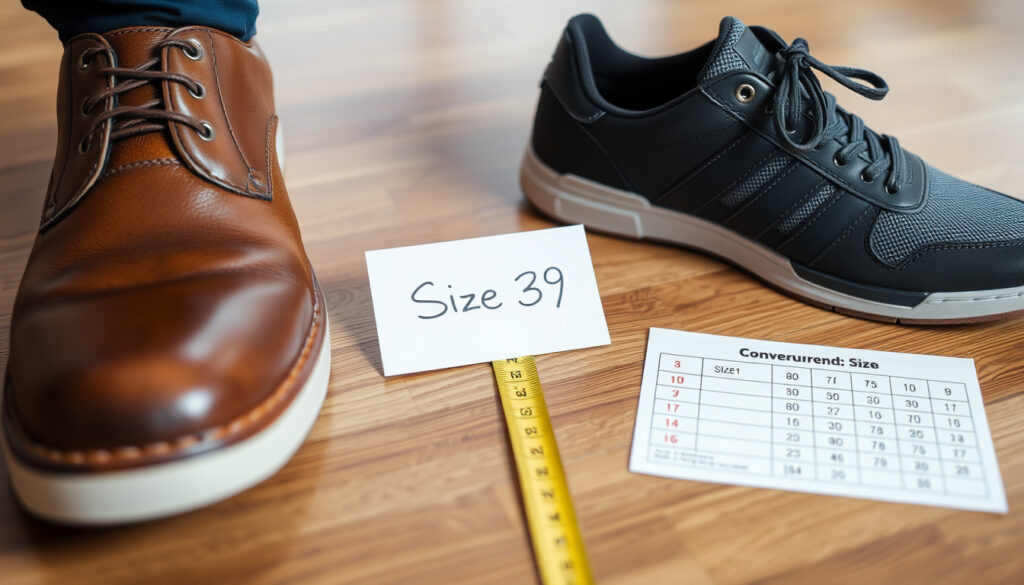
Size 39 in UK – Complete Shoe Size Guide for Women and Men
Whether you are shopping online from a European brand or trying to decode a size tag on a second-hand pair of shoes, the question comes up frequently: what is EU size 39 in UK sizing? The answer depends on whether you are looking at women’s or men’s shoes, and even then, a single conversion number does not always tell the full story. This article breaks down the standard conversions for EU 39, explains how UK and EU sizing systems relate to each other, and covers nearby sizes, clothing equivalents, and the best ways to avoid order mistakes.
Shoe sizing is not fully standardised across borders. A size that fits perfectly in one brand may feel tight or loose in another, even when the number on the box is the same. Understanding the underlying measurements and the typical mapping between EU and UK sizes helps shoppers make more confident decisions.
What is size 39 in UK shoes?
The most direct answer is that EU size 39 converts to UK size 6 for women’s shoes in the majority of retail charts, and to UK size 6 for men’s shoes in many charts, though some maps place men’s EU 39 at UK 5.5. The variability stems from differences in how brands construct their lasts and how they round half sizes.
Standard shoe size conversion for women across major retailers
Standard shoe size conversion for men (approximate, brand dependent)
Approximate clothing size for dresses and tops (highly brand dependent)
Useful reference for cross-border shoppers
Key insights about EU 39 and UK sizing
- UK women’s shoe sizes are roughly 1.5 to 2 steps smaller than their US equivalents and 1.5 to 2 steps larger than EU numbers in the opposite direction
- EU size 39 is a common middle size that fits a foot length of approximately 24.5 to 25 cm
- Half sizes such as UK 5.5 exist in women’s footwear, whereas EU sizes are typically whole numbers
- Men’s EU 39 maps to a different UK number than women’s EU 39 because the lasts and length increments differ by gender
- Measuring foot length in centimetres and comparing it to a brand’s size chart is more reliable than relying on a conversion number alone
- Online returns are often caused by poor fit — correct conversion reduces that risk significantly
Conversion table for EU sizes 38, 39 and 40
| EU Size | UK Women | UK Men | US Women | US Men | Foot Length (cm) |
|---|---|---|---|---|---|
| 38 | 5 | — | 7.5 | — | 24.1 |
| 39 | 6 | 6 | 8.5 | 6.5 | 24.6–25 |
| 40 | 6.5 | 7 | 9 | 7.5 | 25.4 |
These conversions follow the most commonly cited industry standards. Actual fit may vary by brand and shoe type.
How do UK shoe sizes compare to EU sizes?
The UK shoe sizing system and the EU system are built on different base units. UK sizes use barleycorn units, where one full size equals one-third of an inch. EU sizes rely on the Paris point system, with one full size equalling two-thirds of a centimetre. This difference in base measurement means conversions are never perfectly precise.
How to convert UK shoe size to EU
To convert a UK shoe size to EU, the general rule of thumb is to add roughly 33 to the UK number for women and about 32 for men, though this approximation works best in the middle of the size range. For example, UK women’s 6 typically converts to EU 39, and UK men’s 6 converts to EU 39.5 on many charts. Brand-specific variation means this shortcut is only a starting point.
How to convert EU shoe size to UK
Going in the other direction, subtract roughly 33 from the EU number for women and about 32 for men. EU 39 minus 33 gives UK 6 for women. For men, EU 39 minus 33 gives UK 6, though some charts show UK 5.5. The ASOS Women’s Shoe Size Charts place EU 39 at UK 6, while Grivet Outdoors Shoe Size Chart shows similar mappings for both genders.
EU sizing uses whole numbers with occasional half steps such as 39.5, but most brands stick to whole EU sizes. UK women’s sizing includes half sizes like 5.5 and 6.5. This means EU 39 can map to UK 6 in one chart and UK 5.5 in another, depending on whether the chart rounds up or down. Checking the brand’s own size guide is the only way to know for certain.
What are the UK equivalents for EU sizes 38, 39 and 40?
EU sizes 38, 39 and 40 cover a range of foot lengths from about 24.1 cm to 25.4 cm. These three sizes are among the most common in women’s footwear and appear frequently in men’s ranges as well.
EU 38 in UK shoes
EU 38 converts to UK women’s 5 (approximately 24.1 cm foot length). In men’s sizing, EU 38 is uncommon but maps to UK 5 on some charts. The Pavers Women’s Size Grid confirms this mapping for women.
EU 39 in UK shoes
As noted, EU 39 converts to UK women’s 6 and UK men’s 6 in most charts. The foot length is about 24.6 to 25 cm. Some charts from brands such as Steve Madden show EU 39 aligning with UK 5.5 for women, so variability does exist. The Steve Madden UK Shoe Size Chart covers a narrower range but illustrates how brand-specific charts can differ from general tables.
EU 40 in UK shoes
EU 40 converts to UK women’s 6.5 and UK men’s 7 in standard charts. Foot length is approximately 25.4 cm. For women, EU 40 can also appear as UK 7 on some brand charts, especially when the half-size rounding shifts upward.
Place your heel against a wall, mark the longest toe on a piece of paper, and measure the distance in centimetres. Compare that number to the brand’s cm size guide rather than relying on a conversion chart. This method eliminates much of the guesswork and is the approach recommended by most footwear experts.
How do UK clothing sizes compare to EU?
Clothing size conversion between EU and UK follows a different logic than shoe sizes. EU clothing sizes for women are typically even numbers such as 36, 38, 40, and 42, while UK women’s clothing uses sizes 8, 10, 12, and 14. EU 39 is uncommon in clothing because ready-to-wear garments usually use even sizing, but when it appears, it falls between standard brackets.
EU clothing size 38 and 40 in UK
EU 38 in women’s clothing is roughly a UK 10. EU 40 is roughly a UK 12. EU 42 is roughly a UK 14. These conversions are approximate and can vary by up to two sizes depending on the brand, the garment type, and the country of origin. For men’s tailoring, EU 48 is approximately UK 38 chest, and EU 50 is approximately UK 40 chest.
EU 39 in UK clothes
Because EU 39 is not a standard clothing size, it typically corresponds to somewhere between UK 8 and UK 10, leaning toward UK 10 in most brand charts. Some retailers that use odd-numbered EU sizes for specific items may map EU 39 to UK 8 or UK 10, so checking the individual garment’s size guide is essential.
Unlike shoe sizing, where foot length provides a relatively objective reference, clothing sizing involves bust, waist, hip, and inseam measurements that differ dramatically between brands. A EU 40 dress from one label may fit like a UK 10, while the same EU 40 from another label may fit like a UK 14. Always consult the brand’s specific measurements.
How to convert US shoe sizes to UK?
US and UK shoe sizes share a common origin in the barleycorn system, but they diverged over time. US women’s sizes are typically 1.5 to 2 sizes larger than UK women’s sizes. US men’s sizes are about 0.5 to 1 size larger than UK men’s sizes.
US to UK women’s shoe conversion
For women, subtract roughly 1.5 to 2 from the US size to get the UK equivalent. A US women’s 8.5 is approximately a UK 6.5 to 7, but the exact mapping depends on the brand. The Parade Protection Size Guide (PDF) shows EUR 39 = UK 5.5, which illustrates how even official PDF guides can differ from retail charts.
UK to US shoe conversion
To convert UK to US for women, add roughly 1.5 to 2. UK women’s 6 becomes US women’s 8 to 8.5. For men, UK 6 becomes US 6.5 roughly. The relationship is more consistent for men because the US and UK men’s scales are closer together.
How have shoe sizing standards evolved over time?
Shoe sizing has not always been as organised as it is today. Understanding a little of the history helps explain why conversions still cause confusion.
- Pre-20th century: Shoe sizes were based on barleycorn units — one-third of an inch per size. The UK system derived directly from this medieval standard. There was no international coordination, and sizes varied by region and by craftsman.
- 1960s–1970s: The EU introduced the Paris point system, where one full size equals two-thirds of a centimetre. This standardisation aimed to simplify trade between European countries, but it did not replace the UK system, which remained in use in Britain.
- Modern era: Brands often deviate from theoretical standards. Online charts from retailers such as ASOS, Pavers, and Grivet Outdoors now consolidate multiple systems, but each brand may adjust conversions slightly to match the fit of its own products.
How reliable are these conversions?
The conversions provided in this article are based on industry-standard guidelines and data from multiple major retailers. However, reliability depends on several factors that shoppers should keep in mind.
| Established information | Information that remains unclear |
|---|---|
| EU 39 corresponds to a foot length of about 24.5 to 25 cm | Whether a specific brand maps EU 39 to UK 5.5 or UK 6 for women |
| UK women’s size 6 is the most commonly cited equivalent for EU 39 | How much rounding error exists in charts that skip half sizes |
| Men’s EU 39 typically maps to UK 6 in retail charts | Whether unisex size charts follow women’s or men’s mapping for EU 39 |
| Measuring foot length in cm is more reliable than relying on a conversion number | How width fittings (narrow, wide) affect the mapping between EU and UK sizes for the same foot length |
Why does shoe size conversion matter for online shopping?
An estimated 80 percent of online footwear returns are linked to poor fit. When retailers use EU sizing on product pages and shoppers are accustomed to UK sizing, a simple conversion error can lead to an order that does not fit. This is especially true for cross-border purchases where return shipping adds cost and hassle.
Another common pitfall is assuming that EU 39 equals UK 6 for both men and women. That is true for men on most charts, but women’s EU 39 is also UK 6 on most charts — the problem arises when shoppers use a men’s conversion for women’s shoes or vice versa. Trusting a single universal chart without checking gender-specific columns is a frequent source of mistakes.
Width is another factor that conversion charts rarely address. Some brands offer narrow or wide fittings that are not reflected in the EU-to-UK size number, so a correct length conversion may still result in an uncomfortable fit if the width is wrong.
What do the official size charts show?
Several major retailers and guide publishers provide size charts that are referenced widely. The excerpts below reflect the data they publish for EU 39 conversion.
“View our women’s footwear size chart at ASOS. Find out which size is best for your measurements…”
— ASOS, official retail size chart
“UK, EU, US, JP conversion table”
— Pavers, women’s size grid
“Includes US, UK, EU and inches conversion plus measuring tips”
— Grivet Outdoors, comprehensive shoe size chart
What is the best way to find your correct size?
The most reliable approach is to measure your foot length in centimetres — heel to longest toe — and compare that measurement to the brand’s own cm size guide. If the brand does not provide a cm guide, use a conversion chart as a starting point, but order two sizes if you are uncertain and plan to return the one that does not fit. For a broader reference, see the Complete shoe size conversion chart for men, women, and kids and the guide on How to measure your foot length correctly.
Frequently asked questions
What is size 6 in EU?
UK women’s size 6 is approximately EU 39.5–40. UK men’s size 6 is approximately EU 39.
What is size 5 in EU?
UK women’s size 5 is approximately EU 38. UK men’s size 5 is approximately EU 38, though men’s sizes rarely start below 6.
What is size 42 in UK?
EU 42 is UK women’s size 7.5–8 depending on the brand and UK men’s size 8.
What is UK size 9 in EU?
UK men’s size 9 is approximately EU 43. UK women’s size 9 is approximately EU 41.
What is UK size 6 in EU?
UK men’s size 6 is approximately EU 39.5. UK women’s size 6 is approximately EU 39–40.
What is size 39 in UK clothes?
EU clothing size 39 is uncommon since clothing uses even numbers. It is roughly a UK 8–10 depending on the brand. EU 38 = UK 8, EU 40 = UK 10, so 39 falls in between.
Does EU 39 always fit a foot length of 24.5 cm?
Most charts list 24.5 cm as the approximate foot length for EU 39, but some list 24.1 cm for women’s conversions and 24.4–24.6 cm for men’s. Always check the brand’s cm guide.
Why do some charts show EU 39 as UK 5.5?
Brands that round down or use a different last construction may map EU 39 to UK 5.5 instead of UK 6. This is more common in men’s or unisex charts than in women’s charts.
Can I use a men’s conversion for women’s shoes?
No. Men’s and women’s lasts are shaped differently, and the conversion numbers are not interchangeable. EU 39 in men’s may map to UK 6, but women’s EU 39 also maps to UK 6 on most charts — the foot length differs slightly.
What is the most accurate way to convert shoe sizes?
Measure your foot in centimetres and compare it to the brand’s size guide. Conversion numbers are helpful shortcuts, but cm measurements eliminate ambiguity caused by rounding and brand variation.
More related posts
 Interest Rate Predictions UK – Forecasts for 2026 and Beyond
 Toyota Faulty Display Recall – Check If Your Vehicle Is Affected Now
 Heart Splash the Cash – Free Entry Guide and 2025 Update
 Scotland Winter Pensioner Payment 66-79 – Key Facts About £203.40
 Who Is the Most Powerful Doctor in the World – The Real Answer
 14 Day Weather Forecast – UK Bank Holiday Outlook
 Willow Pa ture Country Park – Luxury Lodge , Price & Hone t Review
 Incontinence Pants for Women – Complete 2025 UK Buying Guide
